

Multi Color Schemes
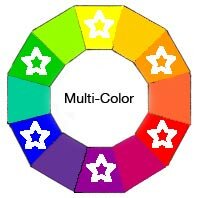
A Multi Color Scheme is defined by working with five to twelve different colors and all their variations.
This is a great color scheme for a fun, young, creative mood.Beware though. You really need a good solid understanding about how color pigments interact.
A Multi Color Scheme gives you freedom to select any group of multiple colors. But choosing your hues without a plan can quickly turn into an unmanageable mess when you start mixing paint.
In our example I’ve selected every second Hue on the Color Wheel. This choice results in using all the Primary and Secondary Colors.
Obviously, working with so many colors at one time will pose a multitude of options. It’s very important to have a clear idea of what mood, color or temperature dominance you want before you select your Hues.
The key to making the best use of a Multi Color Scheme is to make one of the color families dominant by using them for the largest areas. Tone them down a little and balance how much of each you use.
Example of a Multi Color Scheme
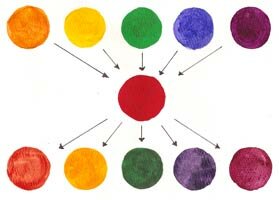
Here, the dominant Mother Color in the center is Red.
The top row shows the original Hues from the Color Wheel. If you used them just as they are, the resulting color scheme would be very bright and maybe even overwhelming. This might be an exciting choice for a party or a circus, but not for much else.
By adding a drop of the Red Mother Color to each original paint color, the intensity is reduced a little. Notice how the color is still vibrant.
Red and Green are Complementary Colors and therefore neutralize each other the most when mixed together. Use this knowledge to create rich neutrals.
The colors near the sides are closest to Red on the Color Wheel so they remain quite intense when red is added. This too is important to note for the accent areas of your work.
Mixing in a tiny drop of the Mother color to every Hue creates a harmonious family. They no longer fight each other for attention and the result is much easier on the eyes.
Even though the mixtures on the bottom row no longer clash, they’re still a bit challenging to balance. The intense orange and yellow will need to be used in small doses to keep from overpowering the other slightly subdued mixtures.
To subdue each color even more you can add more of the Mother Color. Or you can add a little White, Black or both to create a Tint, Tone or Shade.
Painting Tips for a Multi Color Scheme
- Create a dominant cool or warm temperature. Use the cool or warm group of colors for the largest areas.
- Use the same intensity for each color. In other words make them all similarly bright or all similarly subdued.
- Use the Complementary pair to create harmonized neutrals
- Use either the darkest color such as Blue, or the lightest color such as Yellow, for the smallest accent areas. Either of the two extremes will have a better chance of standing out from the crowd.
- Experiment with various balance of mixtures on a piece of paper or in your sketchbooks before you start working on a project. It will give you a better feel of the full range of colors you can achieve.
Check out these Color Schemes
Complementary
Near Complementary
Split Complementary
Triad
Complementary Triad
Modified Triad
Rectangular Tetrad
Square Tetrad
Adjacent Tetrad
Analogous
Analogous Complementary